

Troubleshooting guide
Why Won't My Furnace Ignite?
A Practical Guide to Common Causes and Checks
Prepared by
Bayne L. Vardy — BC Furnace & Air Conditioning Ltd. Serving Greater Vancouver homeowners since 1983.
Updated
The short answer
A gas furnace that will not ignite has stopped at one point in its startup sequence: inducer, pressure switch, hot surface ignitor, gas valve, flame sensor. Confirm power, the gas shut-off and the thermostat first, then watch where the sequence stops — that point names the part.
Read before you open the furnace
Working with gas and electrical systems carries serious risks, including fire, explosion, carbon monoxide poisoning, and electric shock. Many of the checks below involve live voltage, gas valves, or sealed combustion components and should only be performed by a licensed HVAC technician. If you smell gas, leave the home immediately and call your gas utility or emergency services. This guide is for educational purposes only and is not a substitute for professional diagnosis and repair.
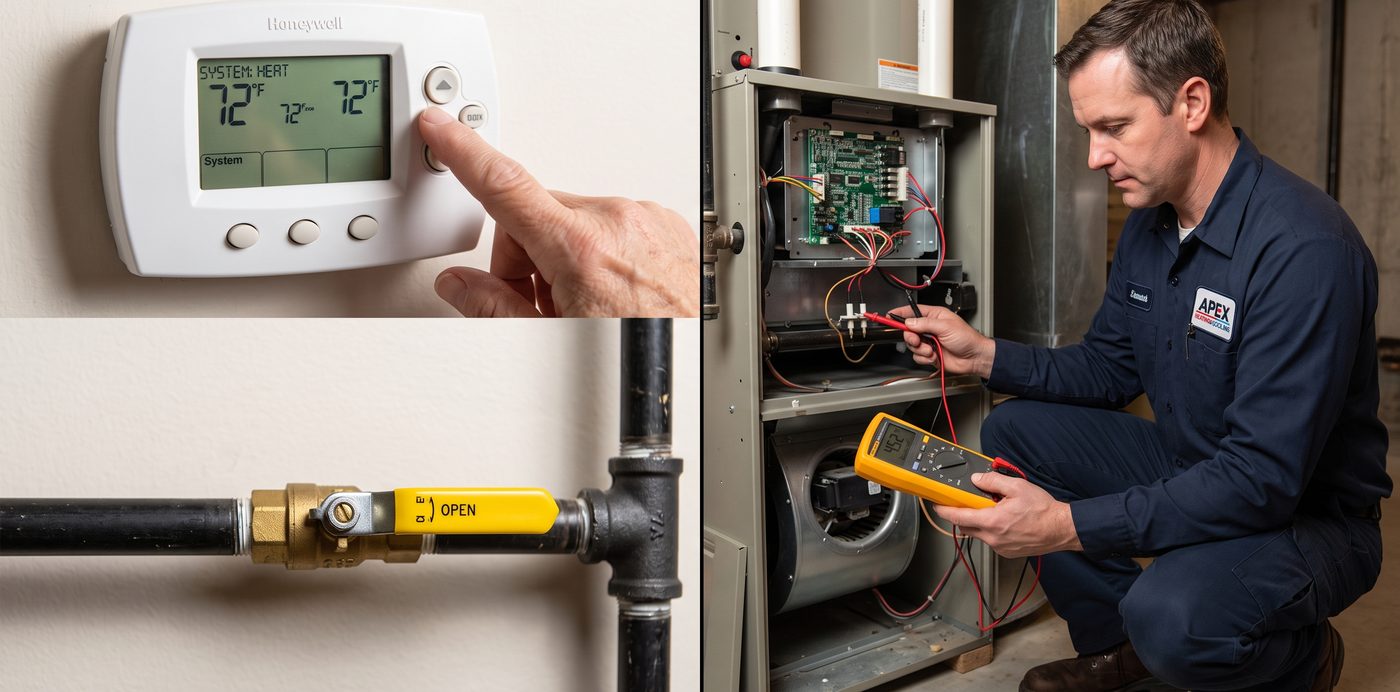
When a gas furnace fails to ignite, the problem can often be narrowed down by following the normal sequence of operation and checking each step in order. Understanding what should happen — and where the sequence stops — helps identify the most likely cause.
Before diving into deeper troubleshooting, start with the simple items that are easy (and safe) for a homeowner to verify.
01Basic Power and Gas Checks
These are the first things to confirm:
- Furnace power switch. Make sure the wall switch that supplies power to the furnace is in the ON position. It is sometimes located near the furnace or on a nearby wall and can be accidentally turned off.
- Gas shut-off valve. Confirm the gas shut-off valve is fully open (handle parallel to the pipe). We have seen cases where children have played with the valve and partially or fully closed it.
- Thermostat. Ensure the thermostat is set to Heat mode and the temperature is set several degrees above the current room temperature so it is actively calling for heat.
02Know the Normal Sequence of Operation
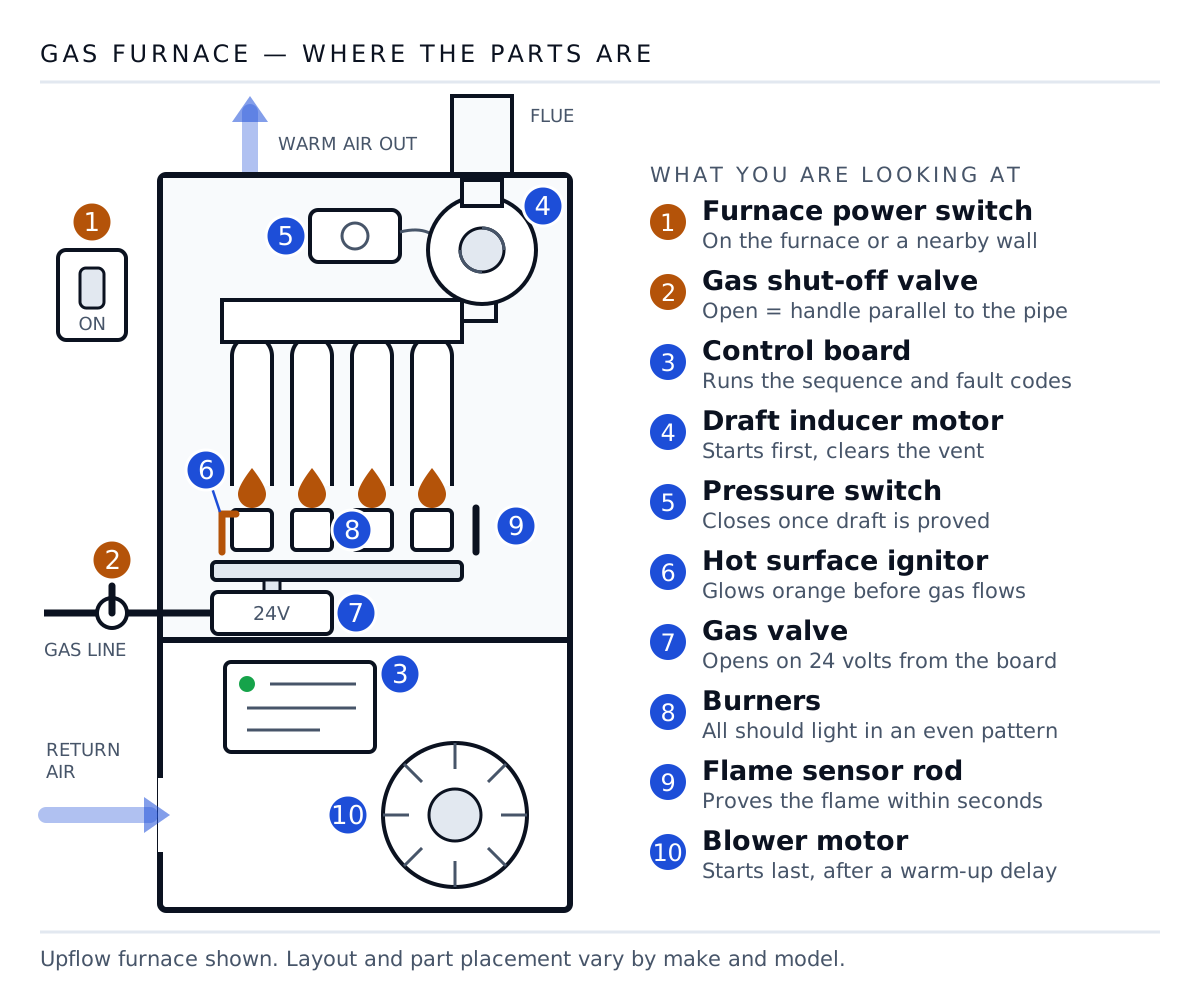
A furnace that will not ignite is often failing at a specific point in its startup sequence. Knowing the normal order of events is essential for effective troubleshooting:
Where does yours stop?
Select the last thing your furnace does. We will show the checks for that step.
Observe where the sequence stops. That point usually points to the component or circuit that needs attention.
Skip the guesswork
Enter your model number for the parts that fit it
03Control Board Power and Status
With the blower door panel properly installed:
- Look for a steady red (or status) light on the control board while the furnace is idle. Many boards show a continuous light when powered and no active fault.
- If there is no light and no error code flashing, verify that power is reaching the furnace. A common point to check is the door switch (the small switch that opens when the blower compartment door is removed).
- If the board has power but shows an error code, note the code (or the flash pattern) before proceeding — it often identifies the failed component or safety.
04Does the Inducer Motor Start?
Turn the thermostat up so it calls for heat and listen/watch for the inducer (draft) motor.
If the inducer does not start:
- Confirm the control board is sending power to the inducer during a call for heat (requires safe voltage testing).
- Check whether the motor is seized or has failed (an ohms/resistance test and visual inspection for free rotation).
- Verify pressure switches are not stuck closed. Many control boards will not start the inducer if a pressure switch is already closed when it should be open.
If the inducer does start: proceed to the pressure switch check.
05Pressure Switch Operation
The pressure switch must prove that the inducer has created proper draft before the ignition sequence continues.
- With the furnace off, the pressure switch should be open (no continuity across the switch terminals).
- During a call for heat, once the inducer reaches full speed, the pressure switch should close.
- If the switch does not close, possible causes include a weak or failing inducer, blocked vent or intake, water in the pressure switch tubing, a cracked or disconnected hose, or a failed pressure switch itself.
06Hot Surface Ignitor (HSI)
After the pressure switch closes, the control board should energize the hot surface ignitor. On most furnaces the ignitor will glow red to nearly white-hot within about 17 seconds (exact timing varies by model).
If the HSI does not glow:
- Confirm the control board is sending the correct voltage (commonly 120 V; some models use 24 V) to the ignitor after the pressure switch closes.
- Test the ignitor for proper resistance (ohms). An open or out-of-range reading usually means the ignitor needs replacement. Hot surface ignitors are consumable parts and do fail with age and use.
07Gas Valve and Ignition
Once the HSI has been powered for the required warm-up time, the control board should open the gas valve (you may hear a distinct click).
- If you hear the board click and the gas valve click, but the burners do not light, the HSI may not be getting hot enough, or there may be a gas supply or valve issue.
- If there is no click from the gas valve after the HSI warm-up period, the problem may lie with the control board, the gas valve itself, or related wiring/safety circuits.
- Always reconfirm that the gas shut-off valve is fully open before concluding the gas valve or control board has failed.
When to Call a Professional
Many ignition failures involve components that require safe electrical testing, gas pressure measurement, or replacement of parts that affect combustion safety. Contact a licensed technician if:
- You are not comfortable or equipped to perform voltage or resistance tests safely.
- The furnace is locking out, flashing error codes, or repeatedly attempting ignition without success.
- You smell gas, hear unusual noises, or notice signs of incomplete combustion.
- Basic checks (power switch, gas valve, thermostat settings, and visual observation of the sequence) do not restore normal operation.
A qualified technician can safely diagnose pressure switch issues, test and replace hot surface ignitors, evaluate gas valves and control boards, and verify proper combustion and venting.
Common questions
- My furnace clicks but the burners never light. Why?
- If you hear the control board click and the gas valve click but the burners do not light, the hot surface ignitor may not be getting hot enough, or there may be a gas supply or gas valve issue. Reconfirm the gas shut-off valve is fully open (handle parallel to the pipe) before concluding the valve or the board has failed.
- How long should a hot surface ignitor take to glow?
- On most furnaces the ignitor glows red to nearly white-hot within about 17 seconds after the pressure switch closes, though exact timing varies by model. If it never glows, either the control board is not sending the correct voltage (commonly 120 V, some models 24 V) or the ignitor itself is open or out of range on an ohms test.
- Why will my pressure switch not close?
- The pressure switch only closes once the inducer has created proper draft. Common causes are a weak or failing inducer motor, a blocked vent or intake, water in the pressure switch tubing, a cracked or disconnected hose, or a failed switch. Note that a switch stuck closed at rest will also stop many boards from starting the inducer at all.
- There are no lights at all on my control board. What now?
- With the blower door panel properly installed, many boards show a steady status light when powered with no active fault. No light and no flashing code means power is likely not reaching the furnace — check the furnace power switch and the door switch, the small switch that opens when the blower compartment door is removed.
Parts in this guide
Read next
Know which part failed? We ship it.
Ignitors, pressure switches, control boards and gas valves on the shelf at our Coquitlam warehouse — same-day pickup in Greater Vancouver, shipped worldwide. Call with your model number and we will confirm the part before you order.