

Troubleshooting guide
Why Does My Furnace Ignite Intermittently?
Testing a Hot Surface Ignitor That Still Glows
Prepared by
Bayne L. Vardy — BC Furnace & Air Conditioning Ltd. Serving Greater Vancouver homeowners since 1983.
Updated
The short answer
An ignitor that has weakened over thousands of heating cycles may still glow without getting hot enough to light the gas reliably. Test its resistance in ohms and compare it with the range for that ignitor’s own brand and model number.
Read before you open the furnace
Turn off power to the furnace before disconnecting anything, and let the ignitor cool to room temperature before touching it. Hot surface ignitors are extremely brittle and can crack or shatter if bumped. Working with gas and electrical systems carries serious risks, including fire, explosion, carbon monoxide poisoning, and electric shock. If you smell gas, leave the home immediately and call your gas utility or emergency services. This guide is for educational purposes only and is not a substitute for professional diagnosis and repair.
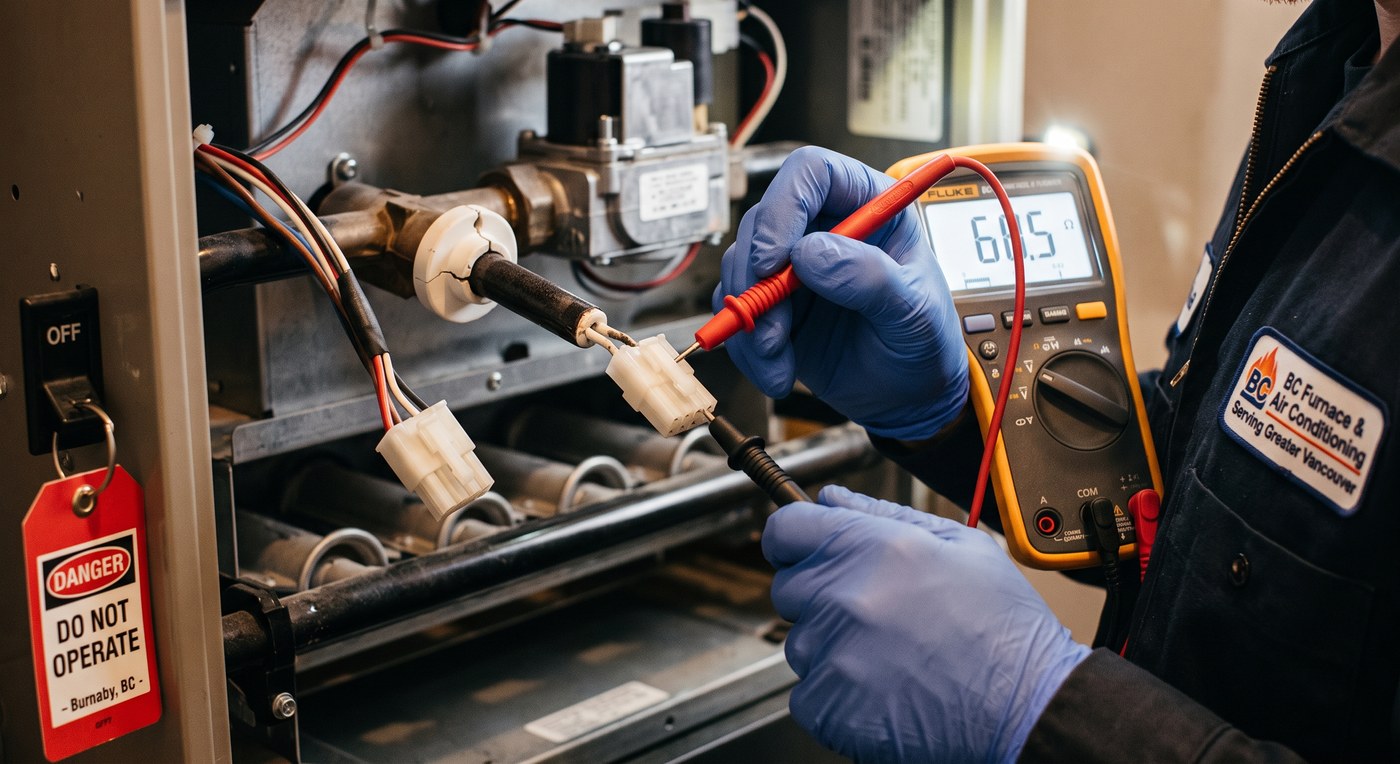
If your furnace is igniting intermittently, or you are concerned about the age and condition of the ignitor, have it tested during your next annual furnace service and safety inspection.
Why a Hot Surface Ignitor Weakens
There is no single replacement schedule that applies to every hot surface ignitor. Every time your furnace starts, the ignitor must heat from room temperature to an extremely high temperature in order to ignite the gas. After hundreds or thousands of heating cycles, the repeated heating and cooling can gradually weaken it.
A failing ignitor may still glow, but it may not always become hot enough to reliably ignite the gas. This can show up as intermittent ignition, delayed ignition, or a furnace that occasionally fails to start.
It is worth remembering that a hot surface ignitor is only one possible cause of intermittent ignition. Other problems within the furnace may produce similar symptoms.
Testing the Resistance With a Multimeter
One way to check the condition of a hot surface ignitor is by testing its resistance with a multimeter set to ohms.
Before testing, make sure the furnace is turned off and the hot surface ignitor has cooled to room temperature.
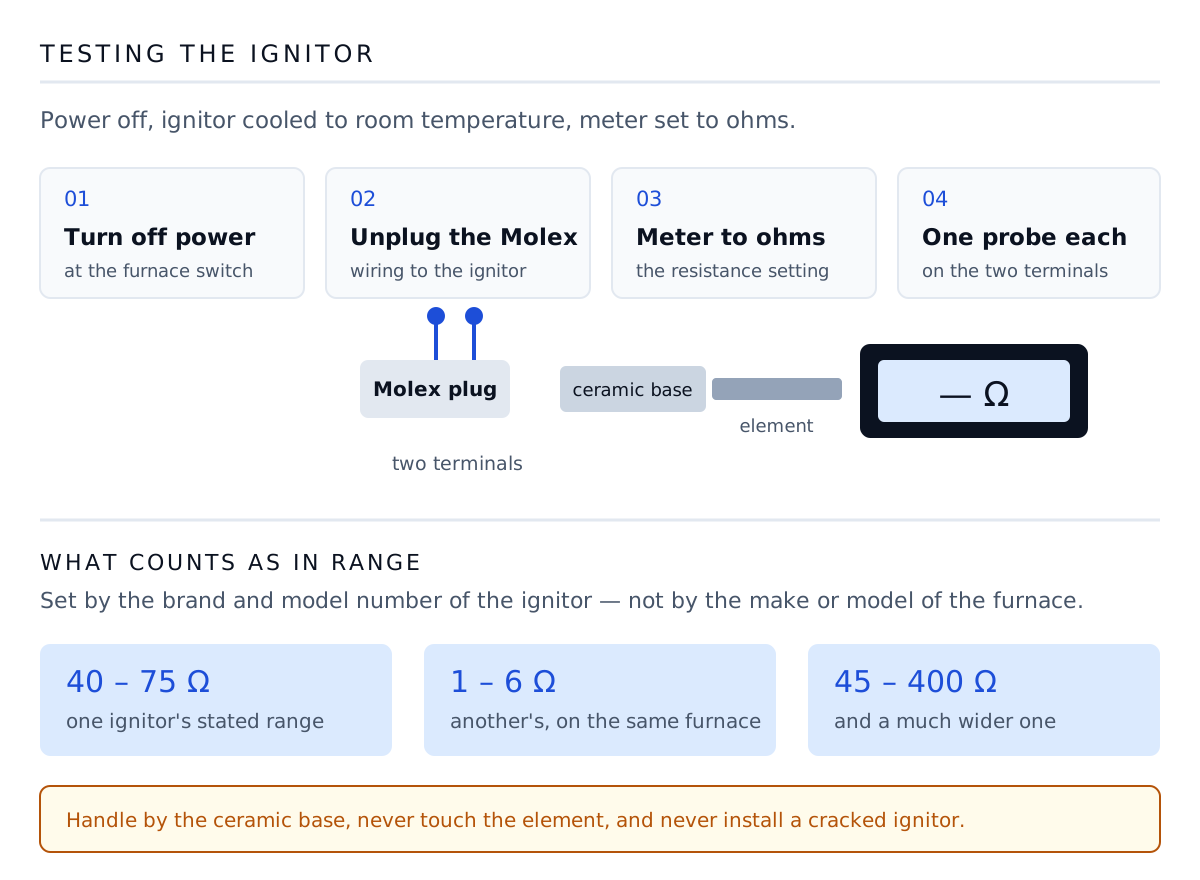
- Turn off power to the furnace.
- Disconnect the Molex plug connecting the furnace wiring to the hot surface ignitor.
- Set your multimeter to measure resistance in ohms.
- Place one probe on each of the two terminals leading directly to the hot surface ignitor.
- Compare the reading with the manufacturer's recommended range for that specific ignitor.
Do not skip this
These checks involve working inside a gas appliance. If you are not equipped and comfortable testing safely with the power isolated, have the ignitor checked by a licensed HVAC technician instead.
What Counts as In Range
The correct resistance range is determined by the brand and model number of the hot surface ignitor, not the make or model of the furnace.
For example, some hot surface ignitors may have a recommended range of approximately 40 to 75 ohms, while others may measure between 1 and 6 ohms. Some have a much wider acceptable range, such as 45 to 400 ohms.
If the ignitor is showing signs of deterioration, has developed cracks or damage, or the resistance reading is outside the manufacturer's recommended range, replacement may help prevent an unexpected furnace breakdown.
Handling a New Ignitor
Hot surface ignitors are delicate and must be handled carefully.
- Do not touch the heating element or tip of a new ignitor with your fingers. Oils and contaminants from your skin may shorten its life.
- Many hot surface ignitors are extremely brittle and can easily crack or shatter if bumped or knocked.
- Whenever possible, handle the ignitor by the ceramic base.
- Do not install an ignitor that is cracked, damaged, or shows signs of deterioration.
When to Call a Professional
The simplest way to know where the ignitor stands is to have it tested during your annual furnace service and safety inspection, before the weather makes it urgent.
- You are not comfortable or equipped to perform resistance tests safely.
- The ignitor is cracked, damaged, or shows visible signs of deterioration.
- The furnace still ignites intermittently after a new ignitor is fitted.
Replacing an ignitor that is out of range or visibly deteriorated may prevent an unexpected breakdown on the coldest night of the year.
Common questions
- Can an ignitor glow and still be bad?
- Yes. A failing ignitor may still glow without becoming hot enough to reliably ignite the gas, which is why it can light the furnace on some cycles and not others. Glowing tells you the circuit is intact; it does not tell you the ignitor is reaching the temperature it needs to.
- How often does a hot surface ignitor need replacing?
- There is no single replacement schedule that applies to every hot surface ignitor. What wears them out is cycles rather than years: each start takes the ignitor from room temperature to an extremely high temperature, and after hundreds or thousands of those the repeated heating and cooling gradually weakens it.
- Why do two ignitors have completely different ohm ranges?
- Because the range belongs to the ignitor, not the furnace. One ignitor may be specified at roughly 40 to 75 ohms, another at 1 to 6 ohms, and another anywhere from 45 to 400 ohms. Look the range up by the brand and model number of the ignitor itself before deciding a reading is out of spec.
Parts in this guide
Read next
Know which part failed? We ship it.
Ignitors, pressure switches, control boards and gas valves on the shelf at our Coquitlam warehouse — same-day pickup in Greater Vancouver, shipped worldwide. Call with your model number and we will confirm the part before you order.