

Troubleshooting guide
Blower Motor Won't Start
When the Furnace Sequence Completes but the Blower Never Runs
Prepared by
Bayne L. Vardy — BC Furnace & Air Conditioning Ltd. Serving Greater Vancouver homeowners since 1983.
Updated
The short answer
If the furnace completes its sequence — inducer, ignitor, burners, flame proven — but the indoor blower never starts, the cause is usually the motor itself, its run capacitor on PSC motors, the control board output, or the blower door safety switch.
Read before you open the furnace
Working with live voltage, capacitors, and furnace electrical components carries a serious risk of electric shock. Capacitors can hold a dangerous charge even after power is turned off. Many of the checks described below require a multimeter and should only be performed by someone experienced and comfortable with electrical testing — or preferably by a licensed HVAC technician. Always turn off power at the furnace switch and the breaker before handling wiring or capacitors. This guide is for educational purposes only.
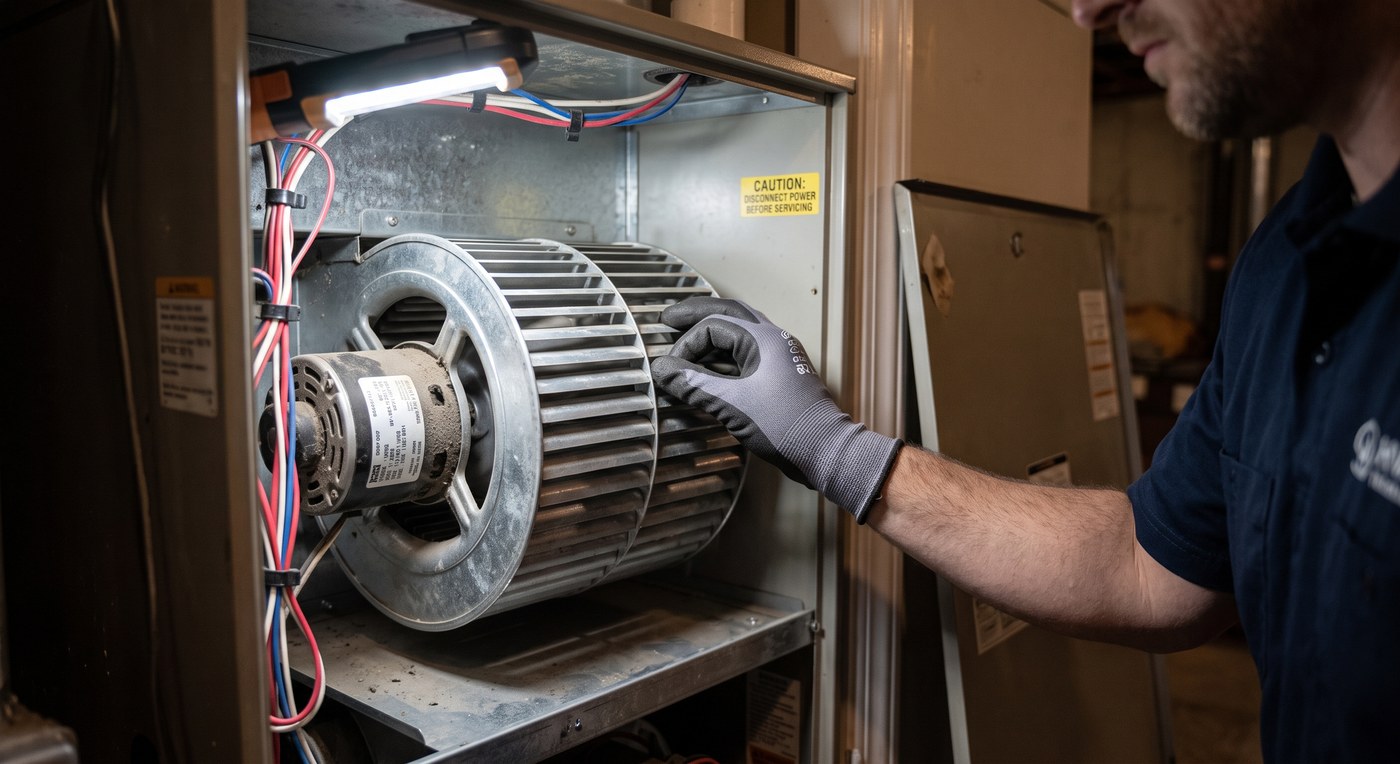
If your furnace goes through its normal sequence of operation — the inducer runs, the ignitor glows, the burners light, flame is proven — but the indoor blower motor never starts, the problem is usually related to the blower motor itself, its run capacitor on PSC motors, the control board output, or the blower door safety switch.
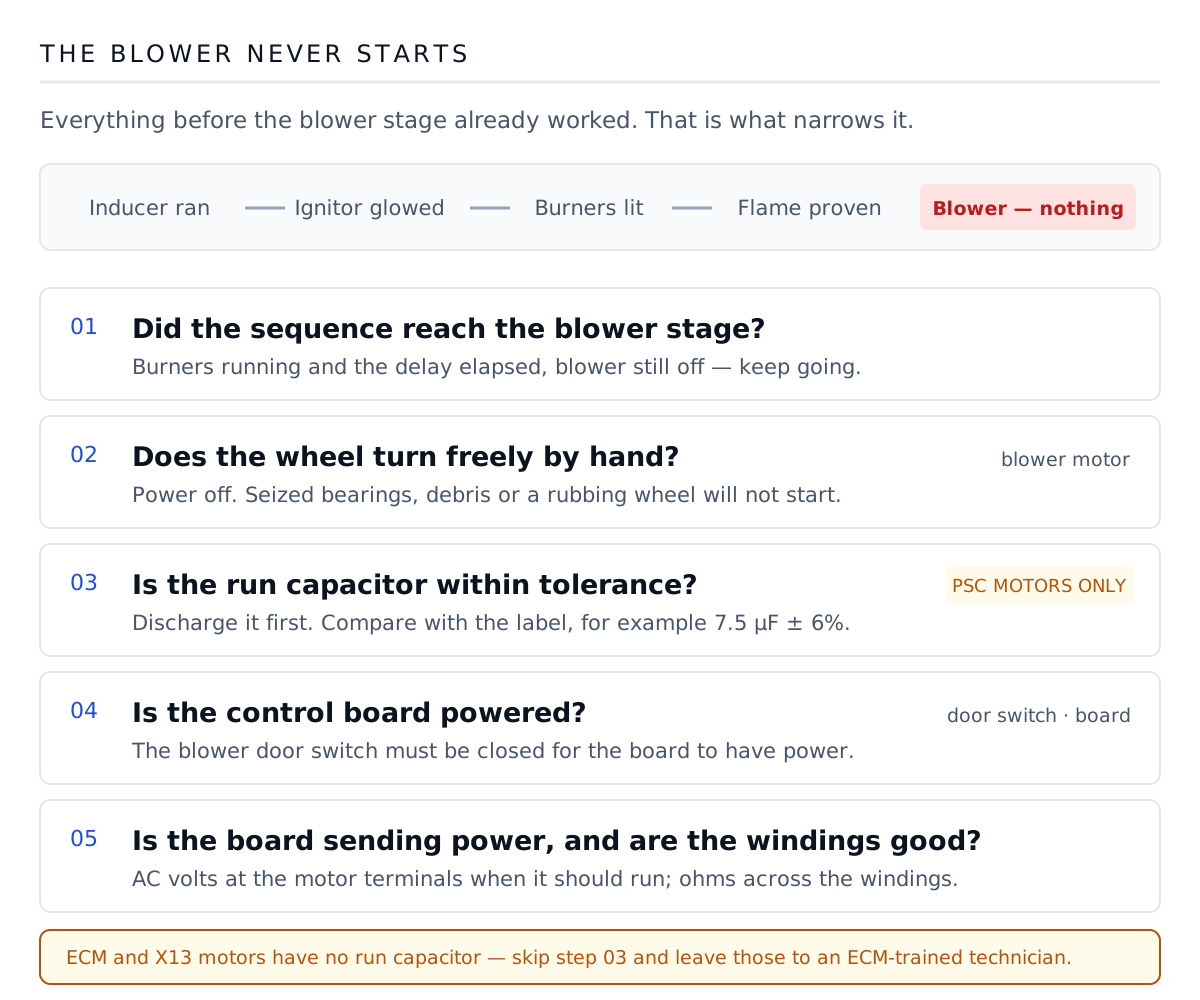
01Confirm the Sequence Reaches the Blower Stage
First confirm that the furnace is completing the earlier steps of the sequence and that the control board has reached the point where the blower should start. If the burners are running and the expected time delay has passed but the blower remains off, further testing is needed.
02Check That the Motor Spins Freely
With power off, carefully check whether the blower wheel and motor shaft turn freely by hand. A seized or hard-to-turn motor — failed bearings, debris, or a rubbing blower wheel — will not start and usually requires motor or blower assembly replacement.
03Check the Run Capacitor (PSC Motors Only)
Many conventional PSC blower motors use a run capacitor. A failed capacitor is a very common reason the motor will not start.
- Turn off all power to the furnace at the switch and the breaker.
- Safely discharge the capacitor before testing. This is typically done by placing the metal shaft of an insulated-handle screwdriver across the capacitor terminals.
- Set a multimeter to the ohms or capacitance setting as appropriate for your meter.
- Compare the reading to the value printed on the capacitor label, for example 7.5 µF ± 6%. A reading significantly outside the tolerance range usually means the capacitor should be replaced.
Note
ECM blower motors, including X13-style motors, do not use a traditional run capacitor. Skip this step on those motors.
04Confirm Power to the Control Board
The blower door safety switch must be closed, with the door properly in place, for the control board to receive power and operate.
- With the blower door securely installed, check whether the control board has a status light or LED illuminated. A steady light usually indicates the board is powered.
- If there is no power indication on the board, the door switch, wiring, or incoming power supply may be the issue.
05Check for Power to the Motor and Motor Condition
If the capacitor and board power check out, the next steps involve verifying that the control board is sending power to the motor and that the motor windings are intact.
- With power off and the motor leads disconnected from the board, an ohms test can be performed on the motor windings to check for open or shorted circuits.
- With power restored and the system calling for the blower, a multimeter set to AC volts can check whether the control board is outputting voltage to the motor terminals at the correct time.
- A common diagnostic step is to place a temporary jumper between the 24 V R and G terminals, then reinstall the door panel. This forces a continuous call for the blower and helps isolate whether the board will energise the motor circuit.
06When Replacement Is Needed
If the motor does not spin freely, the capacitor is out of tolerance on a PSC motor, the board is confirmed to be sending power, and the motor windings test bad — or if the motor simply will not run despite correct power — then the blower motor, and often the capacitor with it, will need to be replaced.
Special Note on ECM and X13 Motors
Variable-speed and constant-torque ECM motors, including many X13-style motors, do not use a traditional run capacitor. Diagnosis of these motors involves different checks — communication signals, module power, and sometimes manufacturer-specific procedures — and is best left to a technician familiar with ECM systems.
When to Call a Professional
Checking that the blower wheel turns freely and confirming the door is properly closed are reasonable homeowner steps. Capacitor testing, live voltage checks, motor winding tests, and motor replacement involve electrical hazards and should be performed by a licensed HVAC technician in most cases.
A blower that fails to start leaves the heat exchanger without airflow. Continued burner operation without the blower can cause high-limit trips and, over time, stress on the heat exchanger.
Common questions
- The burners light but no air comes out. Is that dangerous?
- It is not something to leave running. A blower that fails to start leaves the heat exchanger without airflow, and continued burner operation without the blower can cause high-limit trips and, over time, stress on the heat exchanger. Shut the system off at the furnace switch until the cause is found.
- How do I know whether my blower motor has a run capacitor?
- Conventional PSC motors use one, and a failed capacitor is a very common reason such a motor will not start. Variable-speed and constant-torque ECM motors, including X13-style motors, do not use a traditional run capacitor at all, so there is nothing to test on those.
- What does jumpering R to G actually prove?
- It forces a continuous call for the blower. With a temporary jumper between the 24 V R and G terminals and the door panel reinstalled, the board should energise the motor circuit regardless of the heating sequence, which helps isolate whether the fault is in the board output or in the motor itself.
Parts in this guide
Read next
Know which part failed? We ship it.
Ignitors, pressure switches, control boards and gas valves on the shelf at our Coquitlam warehouse — same-day pickup in Greater Vancouver, shipped worldwide. Call with your model number and we will confirm the part before you order.